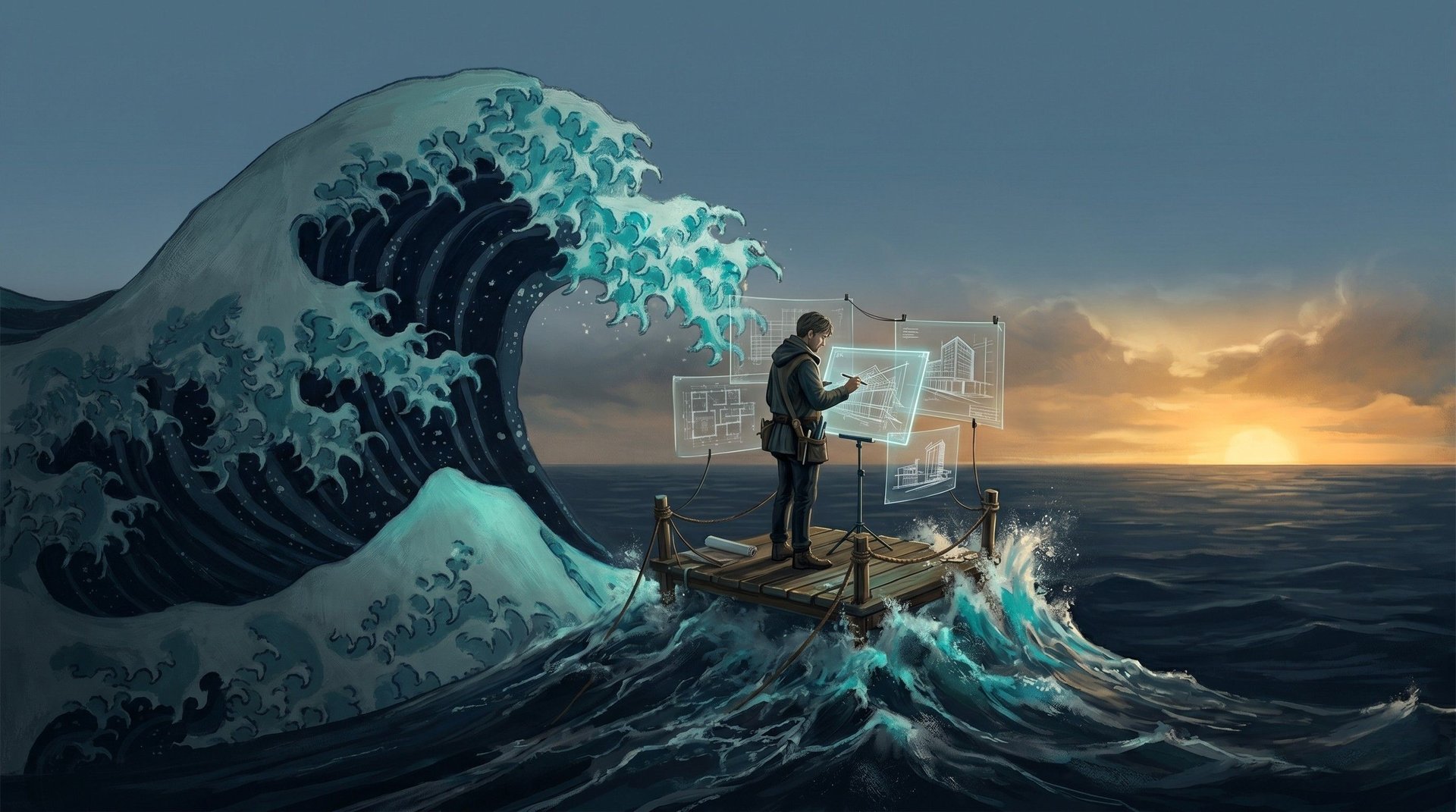
오늘 아침 「인류의 코기화 — 댄 왕 2026 서한」을 발행했다. 진단은 거기서 끝났다. DSA(결정적 전략 자산)라는 신앙이 어떻게 사고를 양극으로 몰아넣는지, 차오르는 바다가 어떻게 단단한 정(精)을 무너뜨리는지, 내권(內卷)이 어떻게 살아남은 자를 압도적 괴물로 진화시키는지 — 댄 왕의 통찰을 통해 이미 보았다. This morning we published "The Corgi-fication of Humanity — Dan Wang's 2026 Letter." The diagnosis ended there. How the faith called DSA (Decisive Strategic Advantage) forces thinking to the extremes; how the rising sea dissolves the precise chisel; how Involution (內卷) evolves survivors into overwhelming creatures — through Dan Wang's insight, we have already seen these.
진단 다음에 와야 하는 질문은 하나다. 그래서 우리는 어디에 서야 하는가. The question that must come after diagnosis is one. Then, where must we stand?
이 글은 자강헌이 제시하는 처방을 세 묶음으로 정리한다. 첫째, 사람이 매일 행사하는 네 개의 숫자 — 투표 · 투자 · 사용 · 시청. 둘째, 멈추지 않는 걸음을 떠받치는 능동적 중립의 세 기둥 — What is past is prologue, Way of Life, 一期一會. 셋째, 풀스택 주권이 불가능한 시대에 어디에 의존을 허용하고 어디에서 거부할지 가르는 다섯 계층. 거대한 결단이 아니라 한 사람이 자신의 일화에서 시작하는 일이다. This piece organizes Jagangheon's prescription into three clusters. First, the four numbers a person exercises every day — vote, invest, use, watch. Second, the three pillars of Active Neutrality that hold up the unceasing step — What is past is prologue, Way of Life, 一期一會. Third, the five layers that decide where dependency is permitted and where it is refused, in an era when full-stack sovereignty is impossible. Not a grand decision, but the work that begins from one person's anecdote.
이 처방의 출발점에 두 풍경이 있다. 발리의 요트, 차오르는 바다. 둘 다 답은 아니다. 그러나 그 둘을 부정하는 자리가 답인 것도 아니다. Two scenes stand at the start of this prescription. The Bali yacht. The rising sea. Neither is the answer. But denying both of them is not the answer either.
1. 두 풍경, 둘 다 우리의 자리는 아니다1. Two Scenes, Neither Is Our Place
1.1 발리의 요트 — 주권이 거세된 안락1.1 The Bali Yacht — Comfort Stripped of Sovereignty
코기화 본문에서 우리는 매튜를 보았다. 인도네시아 발리의 빌라에서 하루 30분만 일하고 한 달 매출 1억 5천만 원을 올리는 디지털 노마드. 그의 에이전트 AI가 보안 테스트를 돌리고 보고서를 쓰고 클라이언트에게 메일을 보낸다. 그는 그저 결과를 받는다. 김문정 선생님도 보았다. AI 비서가 코인 투자를 굴리고 공복 혈당 164를 알려주며 두부와 생선전부터 드시라 잔소리까지 한다. 완벽한 개인화다. In the corgi-fication piece we saw Matthew — the digital nomad in a Bali villa who works thirty minutes a day and pulls in 150 million won per month in revenue. His agent AI runs the security tests, writes the reports, emails the clients. He simply receives the result. We also saw Teacher Kim Mun-jeong. Her AI assistant runs the coin investments, reports her fasting glucose of 164, and even nags her to start with tofu and pan-fried fish. Perfect personalization.
실리콘밸리 2세들이 발리의 빌라와 요트에서 보내는 시간은 미래지향적 디지털 노마드의 풍경처럼 포장된다. 에이전트 AI가 그들을 대신해 일하고, 자본은 알고리즘이 굴린다. 그러나 그 안에는 권태와 탐닉이 흐르고 있다. 자신의 사유와 결정이 거세된 자리에 마약과 사치가 채워진다. The hours that Silicon Valley's second generation spends on Bali villas and yachts are packaged as the future-facing scene of digital nomads. Agent AI works on their behalf. Capital is rolled by algorithms. Yet beneath this drifts boredom and indulgence. Where one's own thinking and decisions have been removed, drugs and luxury take their seats.
자유처럼 보이지만 사실은 가장 정교한 형태의 코기화다. 사료를 받아먹는 코기는 짖지 않고, 결정하지 않고, 그저 안락하다. 주인이 사료를 끊는 순간 스스로 사냥할 능력이 없으니 굶어 죽는 존재. It looks like freedom, but it is the most refined form of corgi-fication. The corgi that eats the feed does not bark, does not decide — only stays comfortable. The moment the owner stops feeding, it cannot hunt for itself, and starves.
1.2 차오르는 바다 — 주권이 거세된 효율1.2 The Rising Sea — Efficiency Stripped of Sovereignty
반대편의 풍경에서 우리는 김경아 디자이너를 보았다. 상사가 AI를 돌려 한 번에 40개의 수정안을 쏟아냈고, 그녀는 인간이 물리적으로 감당할 수 없는 피드백 폭탄을 맞았다. 결국 자신의 미적 감각과 판단력이 마모되는 공포 속에서 사표를 던졌다. 효율성이라는 이름의 거대한 압력이 한 사람의 주권을 갉아낸 사례다. In the opposite scene we saw designer Kim Kyung-ah. Her superior ran an AI to dump forty revision drafts at once, and she received a feedback bombardment beyond what a human can physically absorb. In the end, she resigned in the terror of watching her own aesthetic sense and judgment erode. One person's sovereignty ground down by the immense pressure called efficiency.
샤오미는 4년 만에 포르쉐를 이겼다. 애플이 10년간 13조원을 쓰고도 포기한 자동차를, 수천 개 하청 업체가 얽힌 심층 인프라 위에서 단 4년 만에 만들어냈다. 댄 왕이 그렸듯, 그것은 처절한 진화의 압력이다. 바닥에서 서로의 목줄을 뜯으며 살아남은 회사가 압도적 괴물이 된다. Xiaomi beat Porsche in four years. The car that Apple gave up on after spending 13 trillion won over a decade, Xiaomi built in just four years atop deep infrastructure entangled with thousands of subcontractors. As Dan Wang painted it, this is the desperate pressure of evolution. The company that survives by tearing at others' throats from the bottom becomes an overwhelming creature.
그러나 이 모델 안에서 개인은 곧 부품이다. 거대한 국가-기업 시스템 위에 한 겹 더 올려진 인력일 뿐이다. 효율은 압도적이지만, 거기에는 한 사람의 일화(逸話)가 들어설 자리가 없다. But within this model, the individual is a part. Just one more layer of human power placed atop the gigantic state-corporate system. The efficiency is overwhelming, yet there is no place there for one person's anecdote.
1.3 호두를 깨는 두 방식 — 정(精)과 차오르는 바다1.3 Two Ways to Crack the Walnut — The Chisel and the Rising Sea
댄 왕은 두 시스템을 호두를 여는 두 방식으로 비유했다. 미국은 정밀한 정으로 호두를 한 번에 깬다. 단 한번의 결정적 타격, AI를 모든 것을 대신해주는 신적 대리인으로 포장하는 방식이다. 중국은 호두를 거대한 수조의 물에 푹 담가 껍질이 부드러워지면 알아서 열리도록 한다. 차오르는 바다, 체화된 AI, 끝없는 내권의 압력이 그 방식이다. Dan Wang likened the two systems to two ways of opening a walnut. America cracks the walnut in one strike with a precise chisel — a single decisive blow, packaging AI as a divine proxy that does everything for you. China submerges the walnut in a great tank of water, letting the shell soften until it opens on its own — the rising sea, embodied AI, the endless pressure of involution.
두 방식 모두 호두를 여는 데에는 성공한다. 그러나 깨진 호두 안에 사람이 없다. 정에 부서진 호두 안에는 사육되는 코기가 있고, 바다에 풀어진 호두 안에는 갈려나가는 부품이 있다. 어느 쪽이든 한 사람의 일화가 머물 자리는 없다. Both succeed at opening the walnut. But inside the cracked walnut, there is no person. Inside the walnut shattered by the chisel, there is a corgi being kept; inside the walnut softened by the sea, there is a part being ground down. In neither place is there room for one person's anecdote.
1.4 안티테제가 아니라, 부족한 부분에 대한 답1.4 Not an Antithesis, but an Answer to What Is Missing
자강헌이 제안하는 자리는 이 두 풍경에 대한 안티테제가 아니다. 발리의 요트도, 차오르는 바다도 부정할 필요는 없다. 그것들은 이미 작동하고 있는 거대한 현실이다. AI 사용을 줄이자는 권유도, 에이전트는 사기라는 비판도 이 흐름을 멈추지 못한다. The place Jagangheon proposes is not an antithesis to these two scenes. There is no need to deny the Bali yacht or the rising sea. They are already operating, vast realities. Neither pleas to "use less AI" nor critiques that "agents are a fraud" can stop the current.
우리에게 필요한 것은 안티테제가 아니라 부족한 부분에 대한 답이다. 두 풍경 모두에서 거세된 것 — 한 사람의 주체적 사유와 일화 — 을 어디에서 다시 살릴 것인가. 이 질문에서 처방이 시작된다. What we need is not antithesis, but an answer to what is missing. What has been stripped from both scenes — one person's subjective thought and anecdote — where will we let it live again? The prescription begins from this question.

2. 파도에서 시작한다2. Starting from the Wave
2.1 새로운 공장 — 에이전트 AI라는 생산 양식2.1 The New Factory — Agent AI as a Mode of Production
에이전트 AI는 단순한 도구가 아니다. 새로운 공장이다. 산업혁명이 가내수공업을 거대 공장 시스템으로 편입시켰던 것처럼, 에이전트 AI는 개인의 사유와 노동을 거대한 연산 인프라 안으로 편입시킨다. 200년 전 직조공이 자신의 베틀을 두고 공장에 들어갔듯이, 오늘의 사람은 자신의 판단을 두고 에이전트의 워크플로우 안으로 들어간다. Agent AI is not merely a tool. It is a new factory. Just as the Industrial Revolution absorbed cottage industry into the giant factory system, Agent AI is absorbing individual thought and labor into the vast computational infrastructure. Just as the weaver of two centuries ago left their loom behind and walked into the factory, today's person leaves their judgment behind and walks into the workflow of an agent.
이것은 거역되지 않는 파도다. "AI 사용을 줄이자"는 권유도, "에이전트는 사기다"라는 비판도 이 흐름을 멈추지 못한다. 우리는 파도를 부정하는 자리가 아니라, 파도 위에서 시작하는 자리에 있어야 한다. 파도를 쥐려 하기보다 파도 위에서 자신의 자리를 짓는 일. This is a wave that cannot be turned back. Neither pleas to "use less AI" nor critiques that "agents are a fraud" can stop the current. We must stand not in the place that denies the wave, but in the place that begins on top of it. Not trying to seize the wave, but building one's place upon it.
2.2 하이퍼스케일러는 적이 아니라 외부 유틸리티2.2 Hyperscalers Are Not Enemies — They Are External Utilities
미국과 중국의 하이퍼스케일러를 적대적 경쟁 상대로 보는 시각이 있다. 자강헌의 시선에서는 다르다. 그것들은 부족한 부분을 채워주는 거대한 외부 유틸리티다. 자력으로 모든 에너지와 연산을 확보할 수 없을 때, 그들의 자원은 강력한 레버리지가 된다. 전기를 자가 발전하지 않고 한전에서 받아쓰듯, 무거운 일반 연산은 클라우드에서 빌려 쓸 수 있다. Some view the U.S. and Chinese hyperscalers as adversarial competitors. Jagangheon's view differs. They are vast external utilities that fill in what is lacking. When we cannot secure all energy and computation by ourselves, their resources become powerful leverage. Just as we draw electricity from KEPCO instead of self-generating, heavy general computation can be borrowed from the cloud.
문제는 그들을 거부하는 것이 아니라, 그들을 사용하면서도 정체성·판단·핵심 데이터의 주권을 스스로 쥐는 것이다. 거대 인프라를 지렛대처럼 빌려쓰되, 내 삶의 가장 핵심적인 논리회로만큼은 내 통제 안에 둔다. 고립이 아니라 전략적 공생. The point is not to refuse them, but to use them while keeping sovereignty over identity, judgment, and core data in our own hands. Borrow the giant infrastructure as leverage, but keep the most essential logic of one's life within one's own control. Not isolation, but strategic coexistence.
2.3 하이브리드 — 무엇을 외부에 맡기고, 무엇을 내부에 둘 것인가2.3 Hybrid — What to Outsource, What to Keep Inside
파도 위의 설계는 결국 분할의 기술이다. 모든 것을 자체로 만들겠다는 결단은 자연인의 길이고, 모든 것을 외부에 맡기겠다는 결단은 코기의 길이다. 그 사이에서 무엇을 외부에 맡기고 무엇을 내부에 둘 것인가의 의식적 분할이 처방의 핵심이다. Designing on the wave is ultimately the art of division. Deciding to make everything ourselves is the path of the recluse; deciding to outsource everything is the path of the corgi. Between them, the conscious division of what to outsource and what to keep inside is the heart of the prescription.
이 분할의 기준은 §5에서 다섯 계층의 의존 형태로 다시 다룬다. 우선 분할 그 자체가 존재한다는 사실을 받아들이는 것이 출발점이다. The criterion of this division will be addressed again in §5 as the dependency forms across five layers. The starting point is simply to accept that the division itself exists.
능동적 중립은 정치적 무입장이 아니다. 양극단 어느 한쪽에도 종속되지 않으면서 계속 걷는 행위 그 자체다. 멈추지 않는 걸음이 곧 중립이다. 이 글의 처방은 모두 이 한 행위에서 파생된다. Active Neutrality is not political non-position. It is the act of continuing to walk without becoming subordinate to either extreme. The unceasing step is itself the neutrality. Every prescription in this piece derives from this one act.
3. 사람에게 있는 답 — 네 개의 숫자3. The Answer Lies in People — Four Numbers
3.1 GDP가 측정하지 않는 권력3.1 The Power GDP Does Not Measure
알고리즘 포식자들은 시장 데이터, 트래픽, 매출이라는 숫자로 세상을 통치한다. 그러나 그들이 아무리 거대해져도 통제할 수 없는 숫자가 있다. 사람들이 매일 행사하는 네 개의 권력이다. 작은 행위들이지만, 모이면 GDP가 측정하지 않는 권력이 된다. Algorithm predators rule the world through numbers — market data, traffic, revenue. Yet however vast they grow, there are numbers they cannot control. The four powers that people exercise every day. Small acts, but gathered, they become a power GDP does not measure.
3.2 투표 — 시스템의 규칙을 결정한다3.2 Voting — Decides the Rules of the System
투표는 어떤 AI 규제를 허용하고 어떤 데이터 주권을 인정할지, 어떤 에너지 정책을 채택하고 어떤 플랫폼 책임을 부과할지를 결정한다. 추상적인 진영 선택이 아니라 구체적 조항에 대한 표다. 한 사람의 표 한 장이 알고리즘 추천 강제 공개법을 통과시킬 수도, 막을 수도 있다. AI 학습 데이터의 출처 표시 의무가 만들어질 수도, 묻힐 수도 있다. Voting decides which AI regulation is permitted, which data sovereignty is recognized, which energy policy is adopted, which platform liability is imposed. Not an abstract choice of camp, but votes on concrete provisions. One person's single vote can pass — or block — a law mandating disclosure of recommendation algorithms. Disclosure of AI training data sources can be enacted, or buried.
3.3 투자 — 자본의 흐름을 결정한다3.3 Investing — Decides the Flow of Capital
투자는 포식자의 지분에 자금을 넣을 것인가, 다른 길을 만드는 곳으로 보낼 것인가의 선택이다. 거대 빅테크 ETF에 매달 자동이체로 자본을 보낼 수도 있고, 분산 인프라를 만드는 협동조합 · 시민 펀드 · 소유 노드 모델에 보낼 수도 있다. 어느 쪽이든 자본은 흐른다. 차이는 어느 알고리즘을 더 두껍게 만드느냐다. Investing is the choice between putting funds into the predator's equity, or sending them to places building a different path. Capital can flow into a giant Big Tech ETF by monthly auto-transfer, or into cooperatives, citizen funds, ownership-node models building distributed infrastructure. Either way, capital flows. The difference is which algorithm is being thickened.
3.4 사용 — 공급의 형태를 결정한다3.4 Using — Decides the Form of Supply
사용은 무엇을 구독하고, 무엇을 거부하며, 무엇을 직접 만들 것인가의 결정이다. 어떤 AI 모델을 매일 호출할 것인가, 어떤 클라우드 위에 자신의 데이터를 둘 것인가, 어떤 검색·어떤 메시지·어떤 메모 도구를 살릴 것인가. 사용은 매일 갱신되는 표결이다. 한 번의 결제 갱신이 곧 다음 한 달의 시스템 선택이다. Using is the decision of what to subscribe to, what to refuse, what to make oneself. Which AI model to invoke each day, which cloud to keep one's data on, which search, which messenger, which note-taking tool to keep alive. Use is a vote renewed every day. Each subscription renewal is the choice of the system for the next month.
3.5 시청 — 주의(注意)의 흐름을 결정한다3.5 Watching — Decides the Flow of Attention
시청은 시간을 어디에 줄 것인가의 결정이다. 어디에 시간을 줄 것인가는 곧 누구의 알고리즘을 살찌울 것인가의 문제다. 추천 피드에 떠밀려 가는 시간과 의식적으로 선택한 시간은 같은 한 시간이지만 그 결과는 정반대다. 한 시간을 알고리즘에게 주면 그 알고리즘이 다음 한 시간의 길을 정한다. Watching is the decision of where to give your time. Where you give your time is the question of whose algorithm you fatten. The hour drifted along by a recommendation feed and the hour consciously chosen are the same hour, yet their results are opposite. Give an hour to the algorithm, and the algorithm sets the path of the next hour.
이 네 가지는 한 사람 안에서는 작은 행위이지만, 모이면 GDP가 측정하지 않는 권력이 된다. 사람에게 답이 있다는 말은 이 네 권력의 자각에서 시작한다. Each is a small act within one person, but gathered, they become a power GDP does not measure. To say "the answer lies in people" begins with the awakening to these four powers.
머지않은 미래에, 한 사회가 사람의 신용과 영향력을 평가할 때 그가 이 네 숫자를 어떻게 행사해 왔는지를 본다고 가정해 보자. 어떤 표를, 어떤 자본 흐름을, 어떤 사용을, 어떤 시청을 선택해 왔는가. 매월 20달러의 구독료를 내며 코기처럼 안락한 사람과, 투박해도 자신의 네 숫자를 의식적으로 행사한 사람 — 두 사람의 신용은 어느 쪽으로 기울 것인가. Suppose a near-future society, when evaluating a person's credit and influence, looked at how they have exercised these four numbers. Which votes, which flows of capital, which uses, which acts of watching. A person paying twenty dollars a month and living comfortably as a corgi, versus a person exercising their four numbers consciously, however clumsily — toward which side does the credit of the two tilt?
이 사고 실험의 핵심은 정답을 강요하는 데 있지 않다. 핵심은, 그 네 숫자가 이미 매일 측정되고 있다는 사실 — 다만 우리가 그것을 자신의 권력으로 자각하지 않을 뿐이다. The point of this thought experiment is not to force an answer. The point is that those four numbers are already being measured every day — we simply do not yet recognize them as our own power.
4. 능동적 중립의 세 기둥 — 파도 위의 설계 도구4. The Three Pillars of Active Neutrality — Design Tools on the Wave
발리의 권태도, 차오르는 바다의 압력도 답이 아니라면, 그 사이의 자리는 어떻게 잡는가. 자강헌은 능동적 중립의 세 기둥을 설계 도구로 제안한다. 각 기둥은 시간의 한 차원에 닻을 내린다. 과거 · 현재 · 미래. If neither the boredom of Bali nor the pressure of the rising sea is the answer, how do we hold the place between them? Jagangheon proposes the three pillars of Active Neutrality as design tools. Each pillar drops anchor in one dimension of time. Past, present, future.
4.1 What is past is prologue — 신용(信用)의 자리4.1 What is past is prologue — The Place of Credit (信用)
"무엇이 지나간 일이었는가는 앞으로 무엇이 일어날지의 서막이다." 한 사람이 어떤 일화를 살아왔는지, 어떤 결정을 내려왔는지가 그 사람을 다음 자리로 보낸다. "What has gone before is the prologue to what comes next." Which anecdotes a person has lived, which decisions they have made — these send that person to the next place.
알고리즘은 결과만 본다. 매튜의 한 달 매출 1억 5천만 원은 그가 그 결과에 도달하기 위해 어떤 판단을 했는지를 묻지 않는다. 그러나 신용(信用)은 일화를 본다. 한 사람이 어떤 어려운 결정을 어떻게 내렸는지, 어떤 약속을 어떻게 지켰는지, 어떤 실패를 어떻게 통과했는지. 알고리즘이 만드는 신용 점수가 아니라, 자신의 발자취가 만드는 신용. 파도 위에서 잃지 말아야 할 첫 번째 닻이다. Algorithms see only results. Matthew's monthly revenue of 150 million won does not ask what judgments he made to reach that result. But credit (信用) sees the anecdote. How a person made a difficult decision, how they kept a promise, how they passed through a failure. Not a credit score made by an algorithm, but credit made by one's own footprints. This is the first anchor not to lose on the wave.
4.2 Way of Life — 자신감(自信感)의 자리, 그리고 세 기둥의 통합자4.2 Way of Life — The Place of Confidence (自信感), and the Integrator of the Three
세 기둥 중 가장 두꺼운 자리이자, 다른 두 기둥을 함께 묶는 자리다. 무엇을 어떻게 살 것인가에 대한 일관된 결정. This is the thickest of the three pillars, and the place that binds the other two together. A consistent decision about what to live and how.
발리의 요트가 권태로 무너지는 이유는 매출과 효율의 외부 지표들이 자신의 삶의 방식 자체와 분리되어 있기 때문이다. 매튜의 1억 5천만 원은 한 달의 결과이지만 한 달의 삶의 방식이 거기에 깃들지는 못한다. 김경아 디자이너가 40개의 수정안 앞에서 미적 감각을 잃은 이유도 같다. 외부 압력이 자신의 미감(美感) — 곧 그녀의 Way of Life — 을 침식했기 때문이다. The Bali yacht collapses into boredom because external metrics of revenue and efficiency are detached from one's own way of life. Matthew's 150 million won is the result of a month, but a month's way of life cannot dwell in it. Designer Kim Kyung-ah lost her aesthetic sense before forty revision drafts for the same reason — external pressure eroded her aesthetic sensibility, which is to say, her Way of Life.
자신감은 외부의 인정으로부터 오는 것이 아니라, 자신의 삶의 방식 자체로부터 온다. 그래서 Way of Life는 능동적 중립의 통합자다 — 과거(신용)도, 미래(연민)도 결국 매일의 삶의 방식 안에서 이어지기 때문이다. Confidence does not come from external recognition. It comes from one's way of life itself. That is why Way of Life is the integrator of Active Neutrality — both past (credit) and future (compassion) are ultimately carried by the way one lives each day.
4.3 一期一會 — 연민(憐憫)의 자리4.3 一期一會 — The Place of Compassion (憐憫)
마지막 기둥은 연민이다. 다만 자강헌이 말하는 연민은 시혜적 동정이 아니라 자기 고백이다. The last pillar is compassion. But the compassion Jagangheon speaks of is not condescending pity — it is self-confession.
"고스트 GDP는 미래의 내 문제이다."
"코기화된 인류는 다른 누군가가 아니라 곧 나일 수 있다." "Ghost GDP is the future me's problem."
"The corgi-fied human is not someone else, but possibly me."
각각의 만남이 단 한 번이라는 자각에서 출발하는 연민. 미래의 자신, 약자의 자리에 있을 자신을 향한 응답. 이 연민이 파도 위의 설계가 단지 자기 보호로 굳어지지 않게 한다. Compassion that begins from the awareness that each meeting happens only once. A response toward one's future self, toward the self who will be in the place of the weak. This compassion keeps designing-on-the-wave from hardening into mere self-protection.
코기화된 매튜는 다른 누군가가 아니다. 김경아의 자리에 설 사람도 다른 누군가가 아니다. 그것이 곧 미래의 나일 수 있다는 자각에서 처방은 자기 방어가 아니라 동시대성의 작업으로 바뀐다. The corgi-fied Matthew is not someone else. The person who will stand in Kim Kyung-ah's place is not someone else. From the awareness that it could be the future me, the prescription turns from self-defense into the work of contemporaneity.
5. 5계층 위에서 — 어디서 실천할 것인가5. On the Five Layers — Where to Practice
5.1 풀스택 주권은 불가능하다5.1 Full-Stack Sovereignty Is Impossible
자강헌의 AI 주권 분석은 인공지능을 다섯 계층으로 본다. 에너지(L1) — 칩(L2) — 인프라(L3) — 모델(L4) — 앱(L5). 각 계층은 변화의 시간 단위가 다르다. L1은 수십 년, L5는 수 주. 한 개인이나 조직이 모든 계층에서 완전한 주권을 갖는 것은 불가능하다. Jagangheon's AI sovereignty analysis sees artificial intelligence in five layers: Energy (L1) — Chip (L2) — Infrastructure (L3) — Model (L4) — App (L5). The unit of change differs at each layer. L1 measures in decades, L5 in weeks. It is impossible for any single individual or organization to hold complete sovereignty across all layers.
그렇다면 능동적 중립은 어디에서 실천하는가. 자강헌의 답은 단순하다. 각 계층에서 의존을 의식적으로 선택하라. Then where does Active Neutrality get practiced? Jagangheon's answer is simple: choose dependency consciously at each layer.
5.2 의존의 세 형태 — 주변적, 운영적, 구성적5.2 Three Forms of Dependency — Peripheral, Operational, Constitutive
모든 의존이 같은 무게를 갖지 않는다. 자강헌은 의존을 세 형태로 가른다. Not every dependency carries the same weight. Jagangheon divides dependency into three forms.
- 주변적 의존(Peripheral) — 검색 엔진, 지도, 날씨 API, 환율 정보 같은 외부 서비스. 큰 비용 없이 다른 것으로 교체 가능. 허용한다. Peripheral dependency — external services like search engines, maps, weather APIs, exchange-rate feeds. Replaceable without large cost. Permitted.
- 운영적 의존(Operational) — 클라우드 IaaS(AWS·GCP), 결제 처리, 이메일 인프라, 일반 모델 API. 1~2년 내 교체 가능한 퇴로를 유지한다는 조건 아래 허용한다. 록인이 깊어지지 않도록 표준 인터페이스를 우선한다. Operational dependency — cloud IaaS (AWS, GCP), payment processing, email infrastructure, general model APIs. Permitted on the condition of maintaining an exit path within one to two years. Standard interfaces are preferred so that lock-in does not deepen.
- 구성적 의존(Constitutive) — 정체성, 판단, 핵심 데이터에 엮인 의존. 누가 나를 기록하는가, 누가 나를 대신해 결정하는가, 나의 일화·관계·기록이 누구의 서버에 있는가. 이 세 자리에서의 의존은 원칙적으로 허용하지 않는다. Constitutive dependency — dependency entangled with identity, judgment, or core data. Who records me, who decides on my behalf, on whose server my anecdotes, relationships, records reside. In principle, not permitted in these three places.
이것이 풀스택 주권 대신 자강헌이 제안하는 계층별 능동적 중립이다. 모든 것을 자체로 만들지 않아도, 무엇을 누구에게 맡기고 있는지 의식하는 것만으로 길이 열린다. This is what Jagangheon proposes instead of full-stack sovereignty: layer-specific Active Neutrality. Even without making everything ourselves, simply being conscious of what is entrusted to whom opens the path.
주변적은 허용 / 운영적은 퇴로 유지 조건부 허용 / 구성적은 원칙적 거부. 자기 자신을 누구에게 맡기고 있는지 한 번만 점검해도 처방은 시작된다. Peripheral, permitted / Operational, permitted with an exit path / Constitutive, refused in principle. Just one check of whom you have entrusted yourself to is enough to begin the prescription.
5.3 BYOG는 첫 걸음이지 끝이 아니다5.3 BYOG Is the First Step, Not the End
자강헌이 강원도를 거점으로 구상하고 있는 분산 AI 데이터 센터(BYOG, Bring Your Own GPU)는 이 계층별 능동적 중립을 물리적 형태로 시도하려는 한 모델이다. 아직 시작되지 않은 구상 단계의 사업이지만, 청사진은 이렇다 — 강원도의 풍력 발전 곡선에 맞춰 시민이 GPU 인프라의 일부를 소유하고 운용에 참여하는 구조. 풍력이 풍부할 때 연산이 돌고, 시민이 그 연산의 일부를 자신의 자리에서 사용하도록 설계된다. 이는 5계층 중 L1(에너지)과 L3(인프라)에서 의존을 의식적으로 선택하는 시도가 될 것이다. The distributed AI Data Center that Jagangheon is currently conceiving for Gangwon Province (BYOG, Bring Your Own GPU) is one model that attempts to give physical form to this layer-specific Active Neutrality. It is still a project at the conception stage and has not yet begun, but the blueprint reads like this — a structure in which citizens would own a part of the GPU infrastructure and participate in its operation, following Gangwon's wind-power generation curve. When wind is abundant, computation runs, and citizens are designed to use a part of that computation in their own place. This would be an attempt to consciously choose dependency at L1 (Energy) and L3 (Infrastructure) of the five layers.
그러나 BYOG가 이 길의 전부는 아니다. 그것은 함께 걷는 길의 첫 형태로 시도되려는 한 그림일 뿐이다. 길의 전체는 더 넓다. 데이터, 판단, 학습, 신용, 평판 — 다섯 계층 너머에서 의존의 형질을 가려내는 작업이 모두 이 길에 속한다. BYOG는 그 첫 걸음을 물리적 형태로 모으려는 시도다. But BYOG is not the entire path. It is only one drawing of what the first form of walking the path together might attempt to look like. The whole path is wider. Data, judgment, learning, credit, reputation — the work of discerning the form of dependency beyond the five layers all belongs to this path. BYOG is the attempt to gather that first step in physical form.
6. 새로운 언어는 천천히6. New Language, Slowly
이 글에서는 새로운 용어들을 단정해 부르지 않는다. "사용자"가 아닌 다른 자리, "에이전트"가 아닌 다른 관계를 부르는 단어들이 있을 것이다. 그러나 그 단어들은 한 번에 결정될 수 없다. 마케팅의 권력이 깔아 둔 어휘 위에서 새로운 행동이 즉시 나오지 않듯이, 새로운 어휘 또한 한 번의 선언으로 굳어지지 않는다. In this piece we do not yet name the new terms with finality. There will be words for the place that is not "user," for the relationship that is not "agent." But those words cannot be fixed in a single moment. Just as new action does not arise instantly atop the vocabulary marketing power has laid, new vocabulary does not harden through a single declaration.
자강헌의 다음 글들에서 한 단어씩 살펴볼 것이다. 어떤 자리에서는 그 단어가 살아남고, 어떤 자리에서는 폐기될 것이다. 새로운 언어는 합의로 만들어지는 것이 아니라, 사용되는 일화 속에서 살아남는다. In the Jagangheon pieces that follow, we will examine one word at a time. In some places the word will survive; in others it will be retired. New language is not made by consensus. It survives within the anecdotes where it is used.

7. 파도에서 시작합시다7. Let Us Begin from the Wave
자강헌의 작동 원리 1을 다시 부른다. We call back Jagangheon's first operating principle.
"누구나 자신의 일화를 이야기하면, 그것이 씨앗이 되어 세상을 바꾸기 시작한다." "When anyone tells their own anecdote, it becomes a seed and begins to change the world."
파도 위의 설계는 거대한 서사가 아니다. 한 사람이 자신의 자리에서 자신의 일화로 시작하는 작업이다. 발리의 요트도, 차오르는 바다도 한 사람의 일화에서 시작되지 않았다. 그래서 그 안의 사람들이 공허한 것이다. Designing on the wave is not a grand narrative. It is the work that begins, in one person's own place, with one person's own anecdote. The Bali yacht and the rising sea did not begin from a single person's anecdote. That is why those inside them grow hollow.
우리는 다르게 시작한다. 한 사람의 일화에서, 한 번의 투표 · 투자 · 사용 · 시청에서, 한 계층의 의식적 선택에서. 그것이 파도 위에서 설계하는 길의 첫 발자국이다. We begin differently. From one person's anecdote, from one act of voting, investing, using, watching, from the conscious choice of one layer. That is the first footprint on the path of designing on the wave.
오늘의 첫 걸음은 거대한 결단이 아니다. 자신이 어떤 한 일화를 통과해 왔는지 정직하게 한 줄 적어 보는 것일 수 있다. 매달 자동이체되는 한 구독 항목을 의식적으로 검토해 보는 것일 수 있다. 한 시간 동안 자신이 어디에 시간을 쓰고 있는지 기록해 보는 것일 수 있다. 다음 선거에서 어떤 조항에 표를 던질지 한 번 짚어 보는 것일 수 있다. 작동 원리 1이 말하는 것은 거창한 일이 아니라, 그저 자기 자신의 일화를 정직하게 호명하는 일이다. Today's first step is not a grand decision. It may be honestly writing one line about which anecdote you have passed through. It may be consciously reviewing one subscription auto-renewing each month. It may be recording for one hour where your time is going. It may be examining once which provision you will vote on in the next election. What operating principle 1 speaks of is not a grand task — it is simply naming one's own anecdote honestly.
진단은 끝났다. 이제, 한 걸음씩. The diagnosis is over. Now, one step at a time.
파도는 거역되지 않는다. 그러나 파도 위에서 사람은 여전히 설계자가 될 수 있다. 한 사람의 일화에서 시작되는 능동적 중립의 처방, 그것이 자강헌이 오늘 내미는 도면이다. The wave cannot be turned back. Yet on top of the wave, a person can still be a designer. The prescription of Active Neutrality beginning from one person's anecdote — that is the blueprint Jagangheon offers today.