▶ 영상으로 보기 (8:32) ▶ Watch the video essay (8:32)
올해 5월 말, 상하이에서 열린 국제 회로·시스템 심포지엄(ISCAS) 무대에 화웨이 반도체 부문을 이끌어온 허팅보(何庭波)가 섰다. 그는 미국의 제재로 최첨단 노광 장비의 길이 막혔던 시절을 돌아보며, 정말 출구가 없는 것처럼 느껴졌던 때가 있었다고 했다.
In late May this year, He Tingbo (何庭波), the longtime leader of Huawei's semiconductor business, took the stage at the International Symposium on Circuits and Systems (ISCAS) in Shanghai. Looking back on the years when US sanctions closed off access to the most advanced lithography equipment, she said there was a time when it truly felt like there was no way out.
벽 앞에 서 본 사람은 이 문장을 안다. 시장이 닫히고, 예산이 끊기고, 기술이 막히고, 계획이 무너지는 순간 — 벽은 산업의 크기와 무관하게 누구에게나 같은 얼굴로 온다.
Anyone who has stood before a wall knows that sentence. The moment a market closes, a budget is cut, a technology is blocked, a plan collapses — the wall arrives with the same face for everyone, regardless of the size of the industry.
그런데 2026년의 우리 앞에는 조금 다른 모양의 벽이 하나 더 서 있다. 이 벽은 딜레마의 모양을 하고 있다. 사고를 인공지능에 맡기자니 내 사유의 근육이 풀려가는 것이 걱정이고, 인공지능을 거부하고 혼자 사색하자니 시대에 뒤처지는 것이 두렵다. 외주의 걱정과 거부의 두려움. 어느 쪽을 골라도 무언가를 잃을 것 같은, 양쪽이 모두 벽인 벽이다.
But in 2026, another wall of a somewhat different shape stands before us. This wall has the shape of a dilemma. Entrust your thinking to artificial intelligence, and you worry that the muscles of your own mind are going slack. Refuse it and think alone, and you fear falling behind the times. The worry of outsourcing, and the fear of refusal. A wall where either choice seems to cost you something — a wall on both sides.
딜레마 앞에서 본능은 두 갈래 중 하나를 서둘러 고르는 것이다.
Faced with a dilemma, instinct rushes to pick one of the two horns.
한쪽 뿔의 대가는 이미 측정되고 있다. 잦은 떠넘기기가 비판적으로 사고하는 힘 자체를 갉아낸다는 연구들이 지난 한 해 사이 잇따라 나왔다.[1] 도구를 신뢰할수록 사람의 노력은 분석에서 '받아들이기'로 옮겨가고,[2] 질문은 점점 짧아지고 받아들임은 점점 빨라진다.[3] 걱정은 기우가 아니다. 그렇다고 다른 쪽 뿔이 안전한 것도 아니다 — 흐름을 통째로 거부한 채 버티는 일은, 두려움 그대로, 점점 더 많은 비용을 요구한다.
The price of one horn is already being measured. Over the past year, studies have appeared one after another showing that habitual offloading erodes the very capacity for critical thinking.[1] The more we trust the tool, the more our effort shifts from analysis to acceptance,[2] our questions grow shorter, and our acceptance grows faster.[3] The worry is not unfounded. Nor is the other horn safe — holding out while refusing the current altogether demands, exactly as feared, an ever-rising cost.
허팅보의 벽도 처음에는 양자택일로 보였을 것이다. 막힌 길을 계속 두드리거나, 포기하거나. 그는 둘 다 하지 않았다. 대신 그가 한 일은 뜻밖의 것이었다. 그는 2,200여 년 전의 강으로 갔다.
He Tingbo's wall, too, must at first have looked like a forced choice: keep pounding on the blocked road, or give up. She did neither. What she did instead was unexpected. She went to a river from more than 2,200 years ago.
2,281년 전의 강The River of 2,281 Years Ago
기원전 256년, 진(秦)의 촉군 태수 이빙(李冰)은 민강(岷江)의 홍수 앞에 서 있었다. 당대의 정답은 둑을 높이 쌓아 물을 막는 것이었다. 이빙은 그렇게 하지 않았다. 그는 물과 싸우는 대신 물길의 기하학을 다시 설계했다.
In 256 BCE, Li Bing (李冰), the Qin governor of Shu, stood before the floods of the Min River (岷江). The orthodox answer of his day was to build the dikes higher and dam the water. Li Bing did not. Instead of fighting the water, he redesigned the geometry of its path.
강 한가운데 물고기 입 모양의 분수 제방(어취)을 두자, 강바닥의 높이차 때문에 갈수기에는 물의 6할이 농지로 가는 안쪽 물길로, 홍수기에는 6할이 바깥 물길로 — 조건에 따라 스스로 갈라졌다. 안쪽 물길의 굽이에 낮은 둑(비사연)을 두자, 굽이가 만드는 원심력이 무거운 토사를 바깥으로 튕겨냈다. 마지막으로 산을 깎아 만든 좁은 병목(보병구)이, 상류에 아무리 큰 홍수가 와도 평야로는 일정한 물만 들어가게 조였다. 막은 것이 하나도 없다. 전부 흐름이 스스로 일하게 만든 구조다.
He placed a dividing levee shaped like a fish's mouth (Yuzui) in the middle of the river — and because of the difference in riverbed elevation, the water split itself by condition: in the dry season, six-tenths flowed into the inner channel toward the farmland; in flood season, six-tenths flowed into the outer channel. On a bend of the inner channel he set a low weir (Feishayan) — and the centrifugal force of the bend flung the heavy sediment outward. Finally, a narrow bottleneck cut through the mountain (Baopingkou) throttled the flow, so that no matter how great the flood upstream, only a steady measure of water entered the plain. Nothing was blocked. The entire structure makes the flow do the work itself.
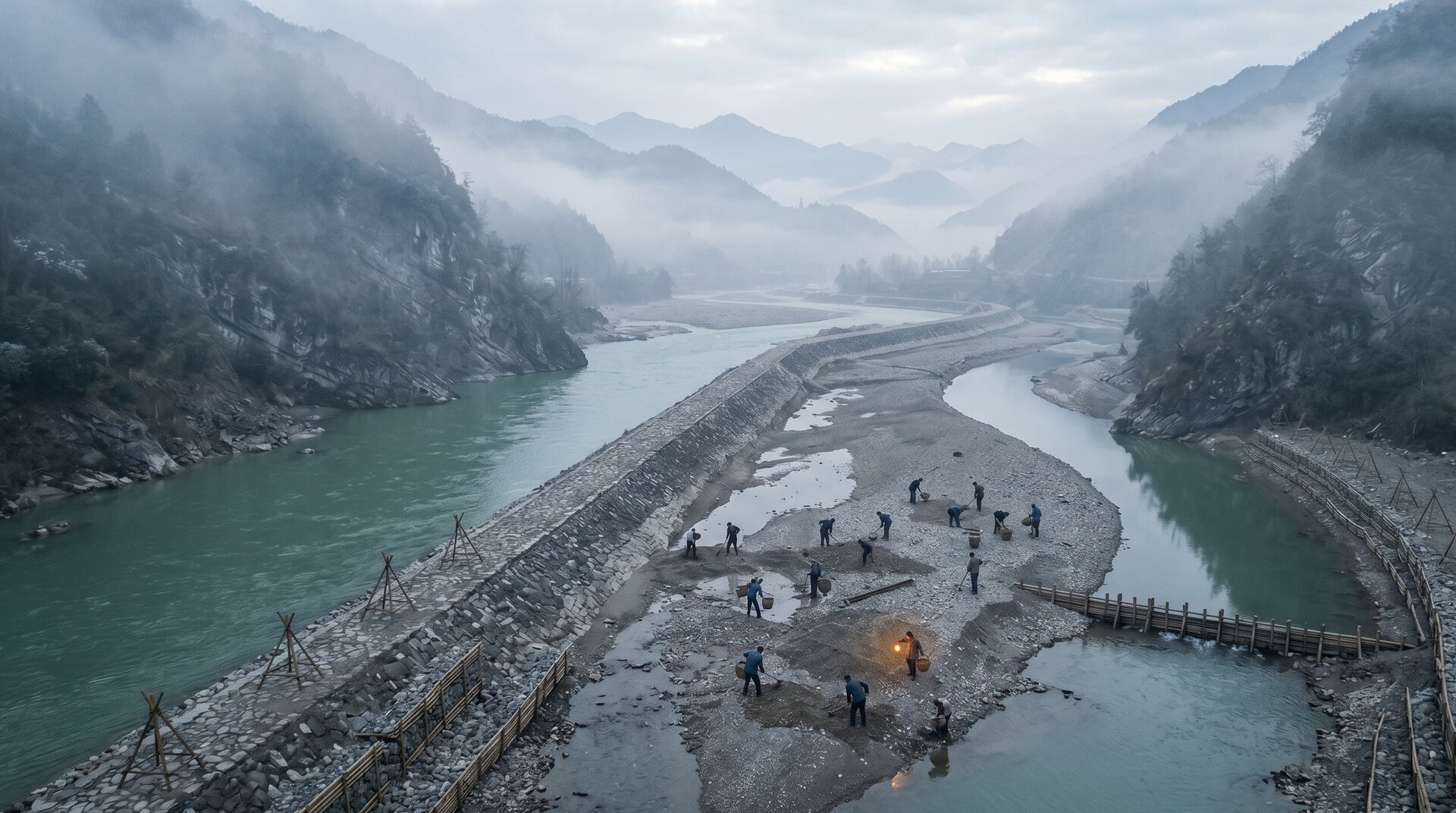
그러나 두장옌(都江堰)의 진짜 비밀은 이 우아한 구조가 아니다. 최근 이 시스템을 수치모델로 분석한 연구들이 한결같이 짚는 대목은 따로 있다.[4] 두장옌은 한 번도 '완성'된 적이 없다. 매년 겨울 물을 끊고 강바닥을 파내는 세수(歲修)가 2,200여 년간 이어졌고, 바닥에는 어디까지 파야 하는지를 알려주는 철제 기준점이 묻혀 있다. 얕게 파면 토사가 쌓여 물길이 막히고, 기준보다 깊게 파면 침식이 강해져 역시 평형이 깨진다. 운영 격언은 여섯 글자다. 심도탄 저작언(深淘灘 低作堰) — 바닥은 깊게 파고, 둑은 낮게 두라.
Yet the real secret of Dujiangyan (都江堰) is not this elegant structure. Recent studies that model the system numerically all point to something else.[4] Dujiangyan was never once 'finished.' Every winter for more than 2,200 years, the water has been cut off and the riverbed dredged — the annual repair known as suixiu (歲修) — and buried in the bed are iron markers that tell how deep to dig. Dredge too shallow, and sediment builds up and chokes the channel; dig below the marker, and erosion strengthens and the equilibrium breaks just the same. The operating maxim is six characters: shen tao tan, di zuo yan (深淘灘 低作堰) — dredge the bed deep, keep the weir low.
천 년을 가는 것은 구조가 아니라, 구조와 손질의 결합이었다.
What lasts a thousand years is not the structure, but the marriage of structure and upkeep.
다시 읽기 — 축의 교체Rereading — Changing the Axis
이 강이 허팅보에게 준 것은 답이 아니라 렌즈였다.
What the river gave He Tingbo was not an answer but a lens.
그 렌즈로 보자 문제가 달라 보였다. 반도체 산업은 수십 년간 한 축 위를 달려왔다 — 트랜지스터를 더 작게. 제재가 막은 것은 정확히 그 축의 다음 칸이었다. 그런데 이빙이 강의 '수량'과 싸우지 않고 '흐름'을 설계했다면, 칩에서 그에 해당하는 것은 무엇인가. 화웨이가 내놓은 답은 시간이었다. 데이터가 트랜지스터와 배선과 메모리를 통과하며 겪는 지연 — 그리스 문자 타우(τ)로 부르는 시간 — 을 새 최적화의 축으로 삼고, 회로를 평면에 펼치는 대신 접어서(LogicFolding) 배선의 임계 경로를 줄이는 구상이다.[5] 크기를 줄일 수 없다면, 시간을 줄인다. 올가을 출시될 차세대 칩에 처음 적용된다고 한다.
Seen through that lens, the problem looked different. For decades the semiconductor industry had been running along a single axis — make the transistor smaller. What the sanctions blocked was precisely the next step on that axis. But if Li Bing did not fight the river's volume and instead designed its flow, what is the equivalent in a chip? Huawei's answer was time. The delay data suffers as it passes through transistors, interconnects, and memory — the time denoted by the Greek letter tau (τ) — becomes the new axis of optimization, and instead of spreading circuits flat, the design folds them (LogicFolding) to shorten the critical paths of the wiring.[5] If you cannot shrink the size, shrink the time. It is said to debut in the next-generation chip due out this autumn.
여기서 멈추면 미담이다. 능동적 중립은 양손을 요구한다. 이 비유는 화웨이가 스스로 택한 서사이고, 검증은 이제 시작이다. 발표된 밀도 향상이 진짜 미세화가 아니라 패키징의 묘수라는 지적이 있고, 층을 쌓을수록 발열과 수율이 함께 나빠진다는 비판도 있다.[5] 화웨이 스스로도 대량 생산으로의 확장은 아직 입증하지 못했다고 인정한다. 판정은 발표문이 아니라 올가을 실제 출하될 칩이 내릴 것이다.
Stop here, and it is a feel-good story. Active neutrality demands both hands. This analogy is a narrative Huawei chose for itself, and verification has only begun. Critics point out that the announced density gains come not from true miniaturization but from clever packaging, and that stacking layers worsens heat and yield together.[5] Huawei itself concedes that scaling to mass production remains unproven. The verdict will be delivered not by the announcement, but by the chips that actually ship this autumn.
그러나 — 이 글의 관심은 화웨이의 성패가 아니다. 벽 앞에서 일어난 '동작'이다.
And yet — this essay's concern is not whether Huawei succeeds or fails. It is the motion that occurred before the wall.
주목할 것은 두장옌이 허팅보에게 답을 주지 않았다는 사실이다. 강은 반도체를 모른다. 2,200여 년 전의 패턴은 다만 그가 자기 문제를 다시 읽게 만들었고 — 진짜 벽은 "장비가 없다"가 아니라 "엉뚱한 축을 최적화해 왔다"일지 모른다는 — 그 다음의 설계는 온전히 그의 몫이었다.
Note that Dujiangyan gave He Tingbo no answer. The river knows nothing of semiconductors. The pattern from 2,200 years ago merely made her reread her own problem — that the real wall might not be "we lack the equipment" but "we have been optimizing the wrong axis" — and the design that followed was entirely her own.
떠넘기기는 답을 받는다. 다시 읽기는 렌즈를 받고, 답은 스스로 만든다.
Offloading receives an answer. Rereading receives a lens, and makes the answer itself.
과거가 서막(prologue)이 된다는 말의 뜻이 이것이다 — 과거는 박물관이 아니라, 지금의 벽을 다르게 보게 하는 살아있는 패턴의 곳간이다.
This is what it means to say that what is past is prologue — the past is not a museum, but a living storehouse of patterns that let us see today's wall differently.
深淘灘 低作堰深淘灘 低作堰
당신 앞의 딜레마로 돌아오자.
Return now to the dilemma before you.
외주의 걱정과 거부의 두려움은 사실 같은 축 위의 두 점이다 — "사고를 누가 하는가"를 전부 아니면 전무로 묻는 축. 그리고 이빙의 여섯 글자는, 2,200여 년 전에 이미 그 축을 다시 읽는 법을 적어 두었다.
The worry of outsourcing and the fear of refusal are in fact two points on the same axis — the axis that asks "who does the thinking" as all or nothing. And Li Bing's six characters wrote down, more than 2,200 years ago, how to reread that axis.
바닥은 깊게 파라(深淘灘). 사유의 강바닥을 직접 파는 일은 누구에게도 넘기지 않는다 — 매년 겨울의 세수처럼, 멈추지 않고. 둑은 낮게 두라(低作堰). 그렇다고 흐름을 통째로 막는 높은 댐을 쌓지도 않는다 — 도구의 강과는 낮은 둑으로 접촉을 유지하되, 흘러오는 것을 판결이 아니라 패턴으로 받는다. 막는 것도 잠기는 것도 아닌, 평형. 두장옌의 바닥에 묻힌 철제 기준점처럼, 그 평형에는 잴 수 있는 깊이가 있다.
Dredge the bed deep (深淘灘). The digging of your own riverbed of thought is handed over to no one — like the dredging of every winter, without ceasing. Keep the weir low (低作堰). Nor do you raise a high dam that blocks the current altogether — with the river of tools, you keep contact through a low weir, receiving what flows in not as a verdict but as a pattern. Neither blocking nor drowning: equilibrium. And like the iron markers buried in the bed of Dujiangyan, that equilibrium has a depth that can be measured.
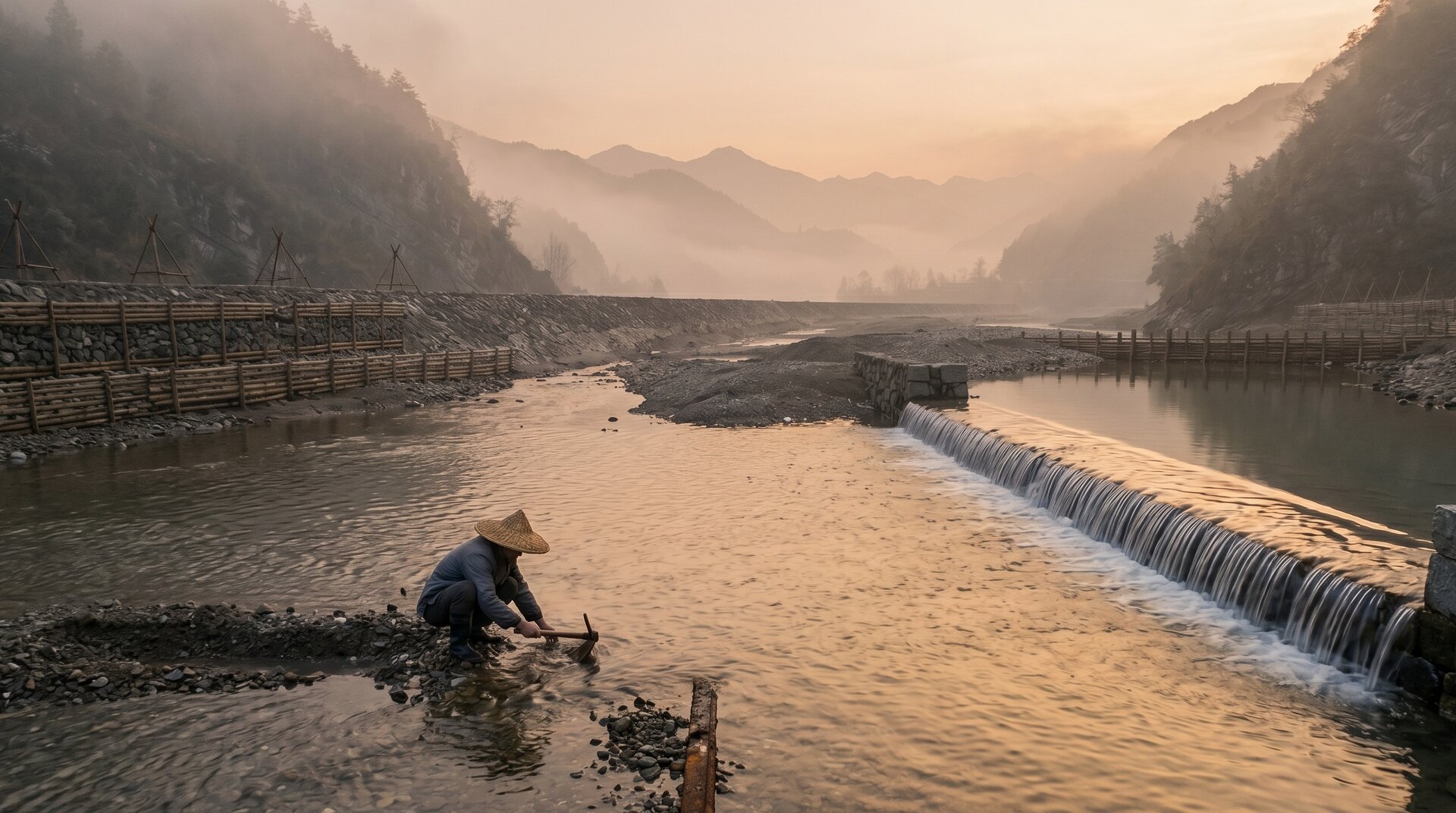
잠시 호흡을 멈추고, 벽을 판결이 아니라 문장으로 다시 읽어보는 것. 시간을 건너온 패턴 하나를 렌즈 삼아 자기 문제를 다시 읽고, 설계는 자기 손으로 하는 것. 스스로 강해진다는 것(自强)의 2026년 버전은 아마 이것이다.
To pause for a breath, and reread the wall not as a verdict but as a sentence. To take one pattern that has crossed the centuries as a lens, reread your own problem, and do the designing with your own hands. The 2026 version of growing strong by oneself (自强) is probably this.
그 손질의 구체적인 방법 — 무엇을 흘려보내고 무엇을 바닥에 남길지, 깊이는 무엇으로 잴지 — 는 다음 글에서 잇는다.
The concrete method of that upkeep — what to let flow past and what to keep on the bed, and how to measure the depth — continues in the next essay.
주(註)Notes
[1] Gerlich, M. (2025). AI Tools in Society: Impacts on Cognitive Offloading and the Future of Critical Thinking. Societies, 15(1), 6. doi.org/10.3390/soc15010006 — 666명 혼합방법 연구. 잦은 AI 사용과 비판적 사고 사이의 유의한 부적 상관을 보고했으며, 매개 요인은 인지적 부하 떠넘기기(cognitive offloading)였다.
[2] Lee, H.-P. (H.), Sarkar, A., Tankelevitch, L., Drosos, I., Rintel, S., Banks, R., & Wilson, N. (2025). The Impact of Generative AI on Critical Thinking. Proceedings of CHI '25. doi.org/10.1145/3706598.3713778 — 지식노동자 319명 조사. 생성형 AI에 대한 신뢰가 높을수록 비판적 사고의 수행이 줄어드는 경향을 보고했다.
[3] Kosmyna, N., et al. (2025). Your Brain on ChatGPT: Accumulation of Cognitive Debt when Using an AI Assistant for Essay Writing Task. arXiv:2506.08872 — EEG 기반 연구. LLM 사용 집단이 가장 약한 두뇌 연결성을 보였고, 저자들은 이를 "인지적 부채"의 축적으로 표현했다.
[4] Zheng, X., Kazemi, E., Gabreil, E., Liu, X., & Chen, R. (2020). Sustainability of the Dujiangyan Irrigation System for over 2000 Years. Sustainability, 12(6), 2431 (CC BY). doi.org/10.3390/su12062431 — 본문의 어취·비사연·보병구 작동 원리, 매년 준설, 철제 기준점(평형 단면), 深淘灘低作堰 해설은 이 논문 §1·§4·§5에 따랐다.
[5] South China Morning Post (2026. 6.). "Is Huawei's new chip scaling law a true breakthrough, or mere hype?" scmp.com — 허팅보의 ISCAS 2026 발표(타우 스케일링 법칙, LogicFolding), 2031년 1.4나노급 '밀도 등가' 목표, 그리고 비판(Omdia: 미세화가 아닌 패키징 효과; Bernstein: 적층에 따른 발열·수율 악화; Counterpoint: 비용·전력·통합 난제)을 종합 보도. 화웨이는 독립 검증된 성능 데이터를 제시하지 않았으며, 본문이 해당 수치를 '목표' 층위로 다룬 이유다.
[1] Gerlich, M. (2025). AI Tools in Society: Impacts on Cognitive Offloading and the Future of Critical Thinking. Societies, 15(1), 6. doi.org/10.3390/soc15010006 — A mixed-methods study of 666 participants reporting a significant negative correlation between frequent AI tool use and critical thinking, mediated by cognitive offloading.
[2] Lee, H.-P. (H.), Sarkar, A., Tankelevitch, L., Drosos, I., Rintel, S., Banks, R., & Wilson, N. (2025). The Impact of Generative AI on Critical Thinking. Proceedings of CHI '25. doi.org/10.1145/3706598.3713778 — A survey of 319 knowledge workers finding that higher confidence in generative AI is associated with less enaction of critical thinking.
[3] Kosmyna, N., et al. (2025). Your Brain on ChatGPT: Accumulation of Cognitive Debt when Using an AI Assistant for Essay Writing Task. arXiv:2506.08872 — An EEG study in which LLM users showed the weakest brain connectivity; the authors describe the effect as an accumulation of "cognitive debt."
[4] Zheng, X., Kazemi, E., Gabreil, E., Liu, X., & Chen, R. (2020). Sustainability of the Dujiangyan Irrigation System for over 2000 Years. Sustainability, 12(6), 2431 (CC BY). doi.org/10.3390/su12062431 — This essay's accounts of the Yuzui, Feishayan, and Baopingkou, the annual dredging, the buried iron markers, and the maxim 深淘灘低作堰 follow §1, §4, and §5 of this paper.
[5] South China Morning Post (June 2026). "Is Huawei's new chip scaling law a true breakthrough, or mere hype?" scmp.com — Coverage of He Tingbo's ISCAS 2026 presentation (Tau Scaling Law, LogicFolding), the 1.4nm-class density-equivalence target for 2031, and the criticism (Omdia, Bernstein, Counterpoint). Huawei has presented no independently verified performance data, which is why this essay treats the figures as targets.